
Resume


Warriors of
Light Institute
An educational online platform on international humanitarian law Law of Armed Conflict
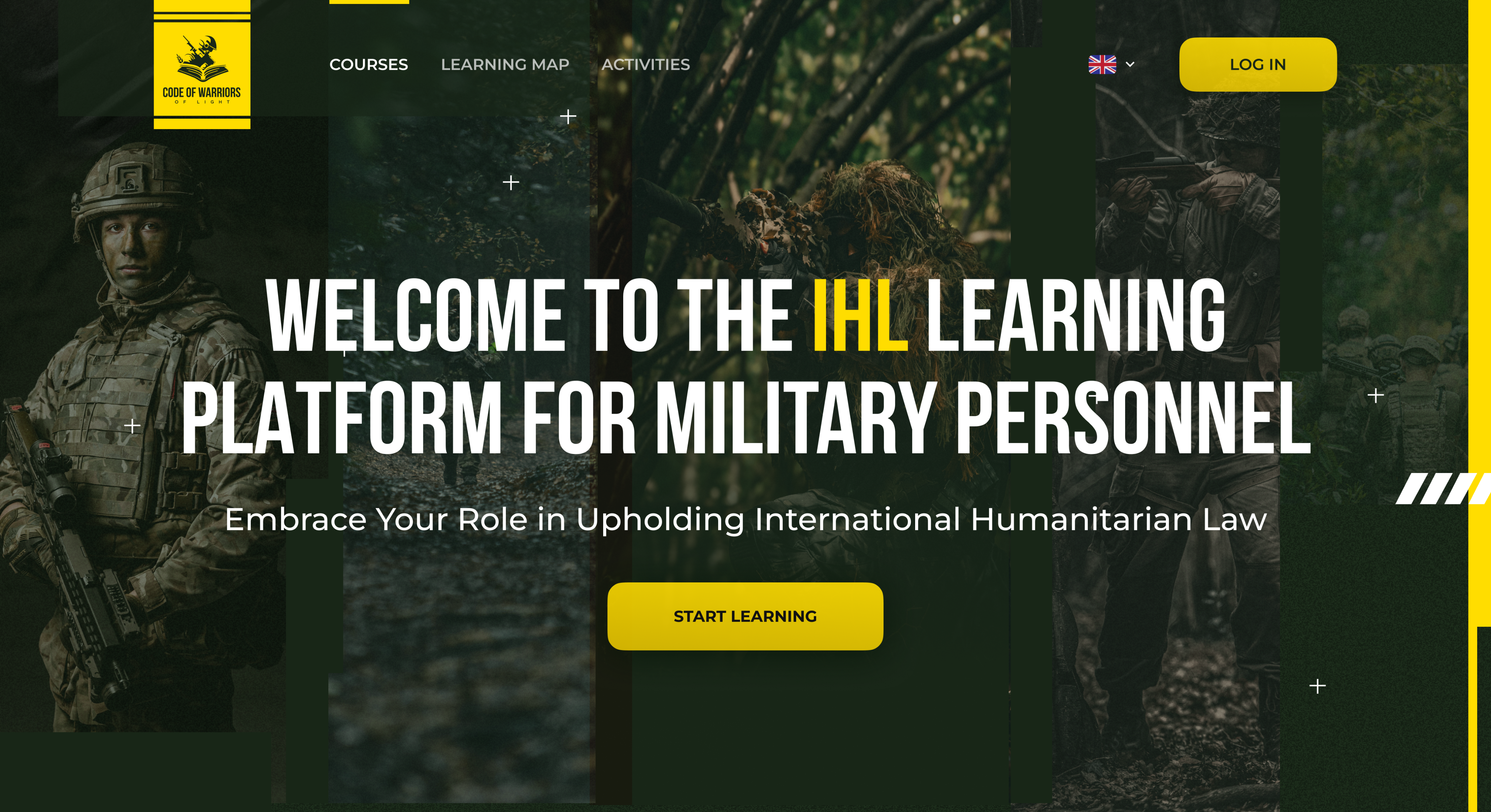
Research & Discovery | User Insights | Brainstorming | Structure & Flow | Wireframes | UI Design | Prototyping | Testing | Launch & Handoff | Ongoing Improvements



Teaching the Rules of War
In a world where war has once again become a daily reality, the question of how to protect human dignity doesn’t feel abstract – it’s urgent. International Humanitarian Law (IHL), also known as the Law of Armed Conflict, exists to limit harm to civilians and regulate how wars are fought. But rules only matter if people know them.
Geneva Call, a humanitarian organisation working in conflict zones, wanted to make IHL training accessible to Ukrainian military personnel – from soldiers in the trenches to officers in training bases. The goal was clear; the path wasn’t.


From Boring Textbook to Battle-Ready Training Tool
The Challenge
At first, we were handed a massive trove of IHL theory. Expertly written, yes. Engaging? Not at all. Imagine sitting at a base with no signal, trying to read something that feels like a high school law book. That’s not how anyone learns under stress.
I knew this approach wouldn’t work. So the question became: what would IHL training look like if it was designed for someone learning between tasks, with minutes to spare and no internet?
No Time, No Internet
Our first assumption was right: most soldiers had limited or unstable internet access. Add to that the biggest barrier of all – time. Long lectures and big articles were out of the question.
This meant rethinking everything from the ground up. But guesswork only goes so far. Before making design decisions, I turned to the people who mattered most – the users. I moved quickly from desk research and team notes to surveys and interviews with soldiers and trainers. Their insights shaped every choice.
Listening First: What Soldiers Told Me
To make sure I wasn’t just building from assumptions, we ran interviews and surveys with both regular soldiers and senior personnel involved in shaping training and policy
What Interviews Showed
Conversations happened in quick bursts – between rotations, on the move, or in rare moments of quiet. Despite different roles, a few truths stood out:
- Training had to be flexible, intuitive, and short. Soldiers only had minutes, not hours.
- Interactive beats passive — videos, images, quizzes worked better than text.
- Duolingo was the benchmark for engaging learning.
- Credibility mattered: many thought IHL was invented by outsiders, but it was actually written by commanders with real battlefield experience.
What the Surveys Showed
Survey results confirmed and expanded on these insights:
- 49% had stable internet, 44% had interruptions, 7% had little or none → offline-first was a must.
- Only 12% used learning platforms daily; almost half rarely used them.
- Main barriers: lack of time (46%), motivation (23%), poor internet (19%), heavy theory (12%).
- The takeaway: this wasn’t about adding more content — it was about making every minute count.

Internet Access
Most users couldn’t rely on stable internet – the training needed to work even offline

Stable
49%
Interrupted
44%
Poor/None
Barriers to Learning
Training had to be short, engaging, and connection-proof
Lack of time
46%
Motivation
23%
Poor internet
19%
Heavy theory
12%
Prototyping the Experience
With input from interviews and surveys, I moved from sketches to wireframes to full mockups. Two distinct learning paths emerged — Soldier and Officer — each tailored in tone and content.
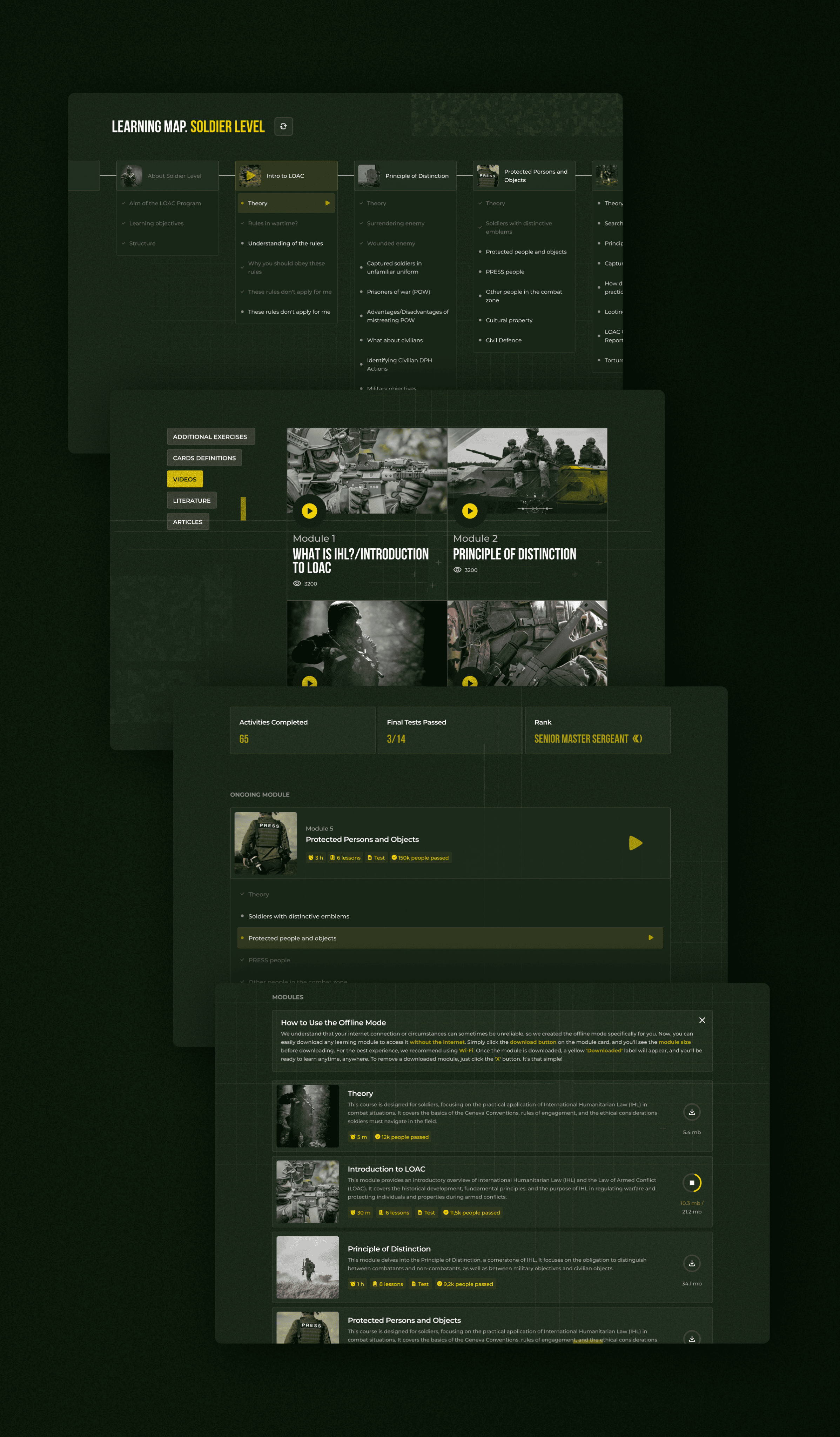
To keep learning clear and motivating, I designed a visual learning map. It gave soldiers a sense of structure: showing what they’d completed, what came next, and making it easy to jump back to earlier lessons.
And because connectivity was unreliable, the platform was built offline-first: lessons downloaded locally, progress synced later. Each module lasted just a few minutes — short enough to complete in downtime, long enough to stick.
Offline-First Design
Lessons could be downloaded and stored locally, so soldiers could keep learning even without signal. Progress synced automatically once back online.
Bite-Sized Learning
Content was broken into short, reusable modules using SCORM. Each piece was interactive, flexible, and designed for quick learning in high-pressure contexts.
Interactive Activities
From videos and soldier dialogues to scenarios, quizzes, and matching games — learning stayed active, not passive.
Gamification
Progress unlocked new “Military Rank” levels. Simple, lightweight gamification gave users a sense of achievement and motivation to continue.
Additional Exercises
A separate Activities page offered optional practice — scenarios, tests, and extra materials — for those who wanted to go deeper without cluttering the main path.
Myths Busters
Right at onboarding, I cleared up a common misconception: IHL was written by experienced commanders, not outsiders. That context built trust from the start.


Designing for Engagement
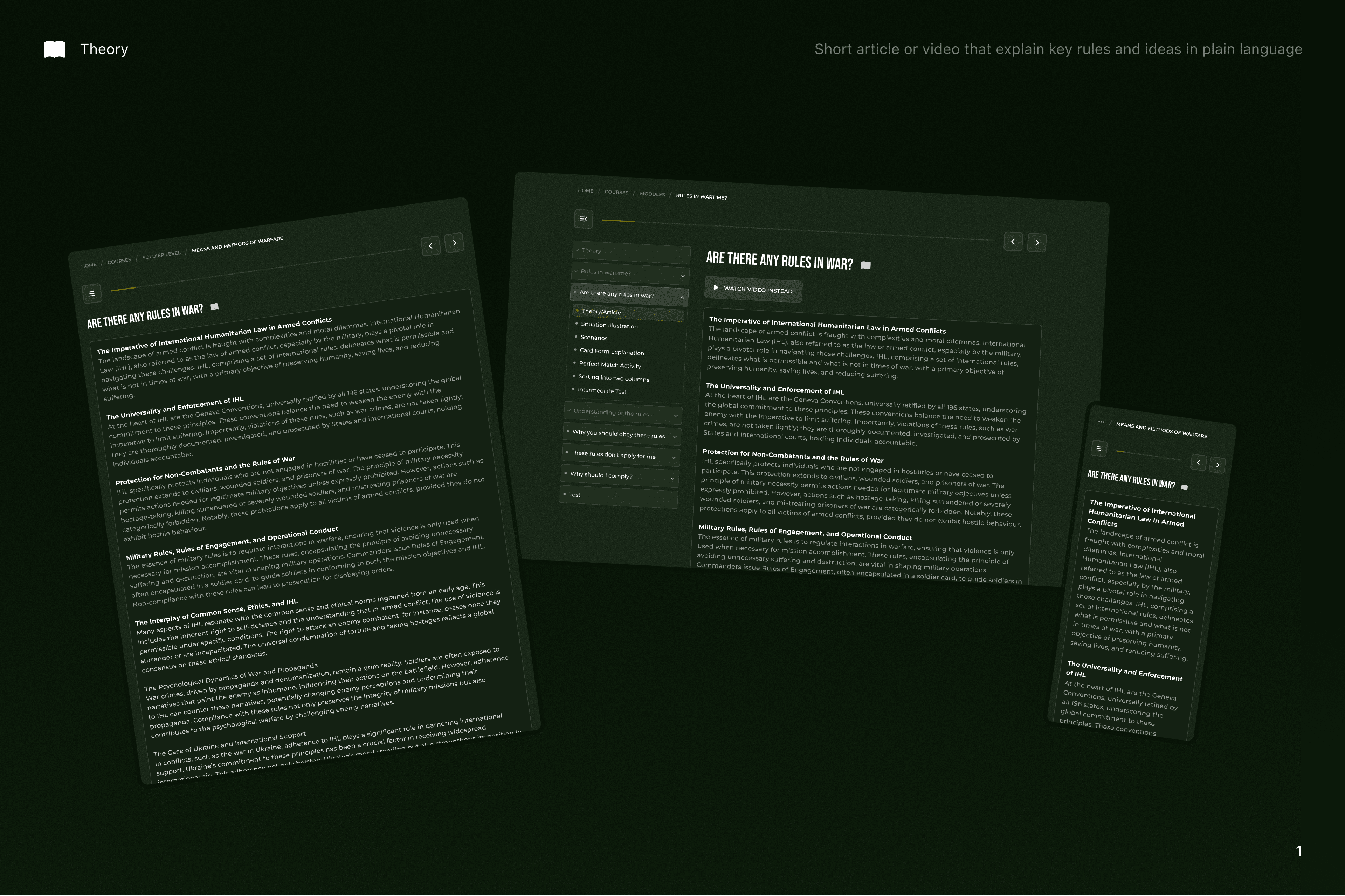
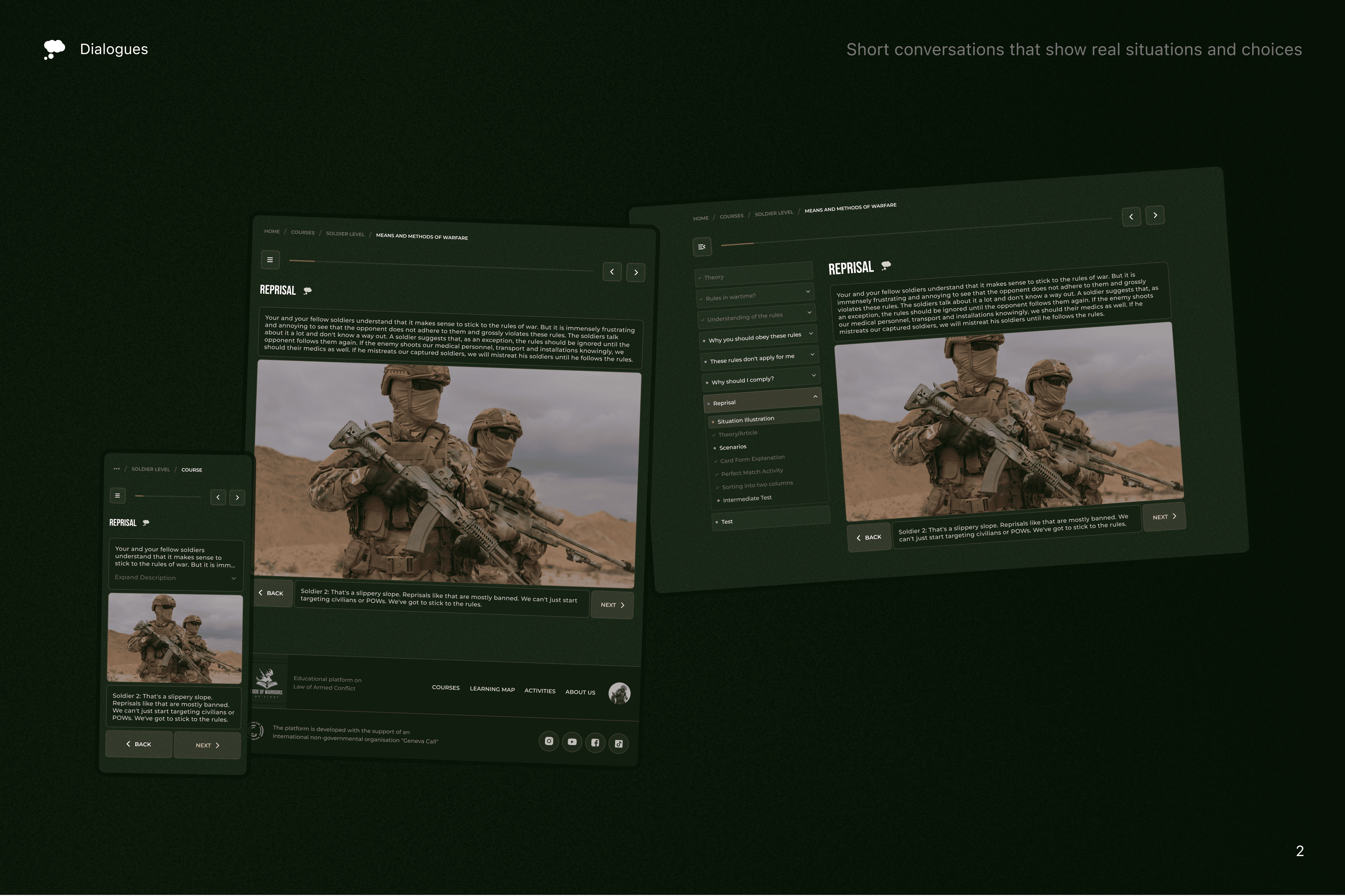
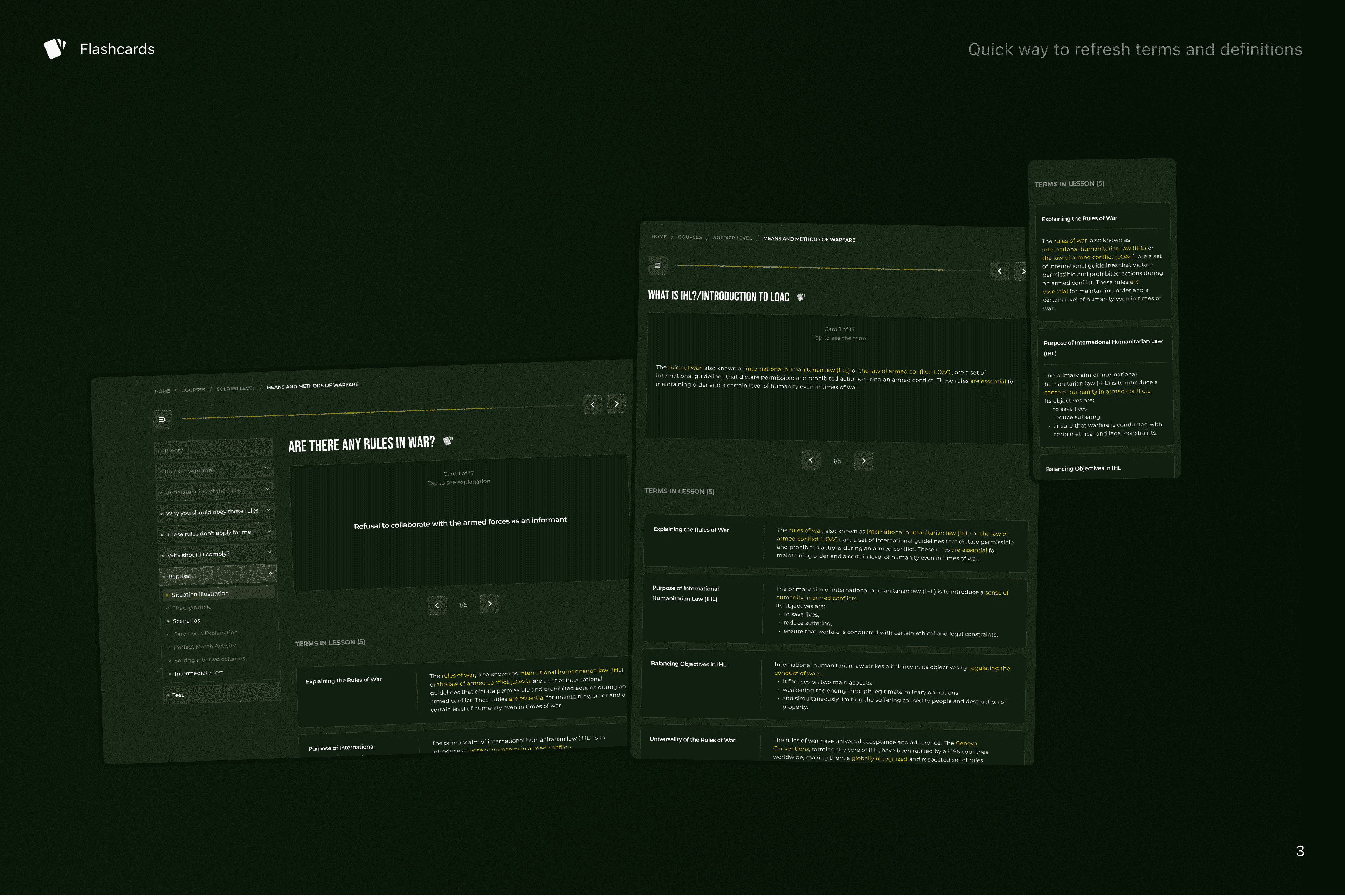
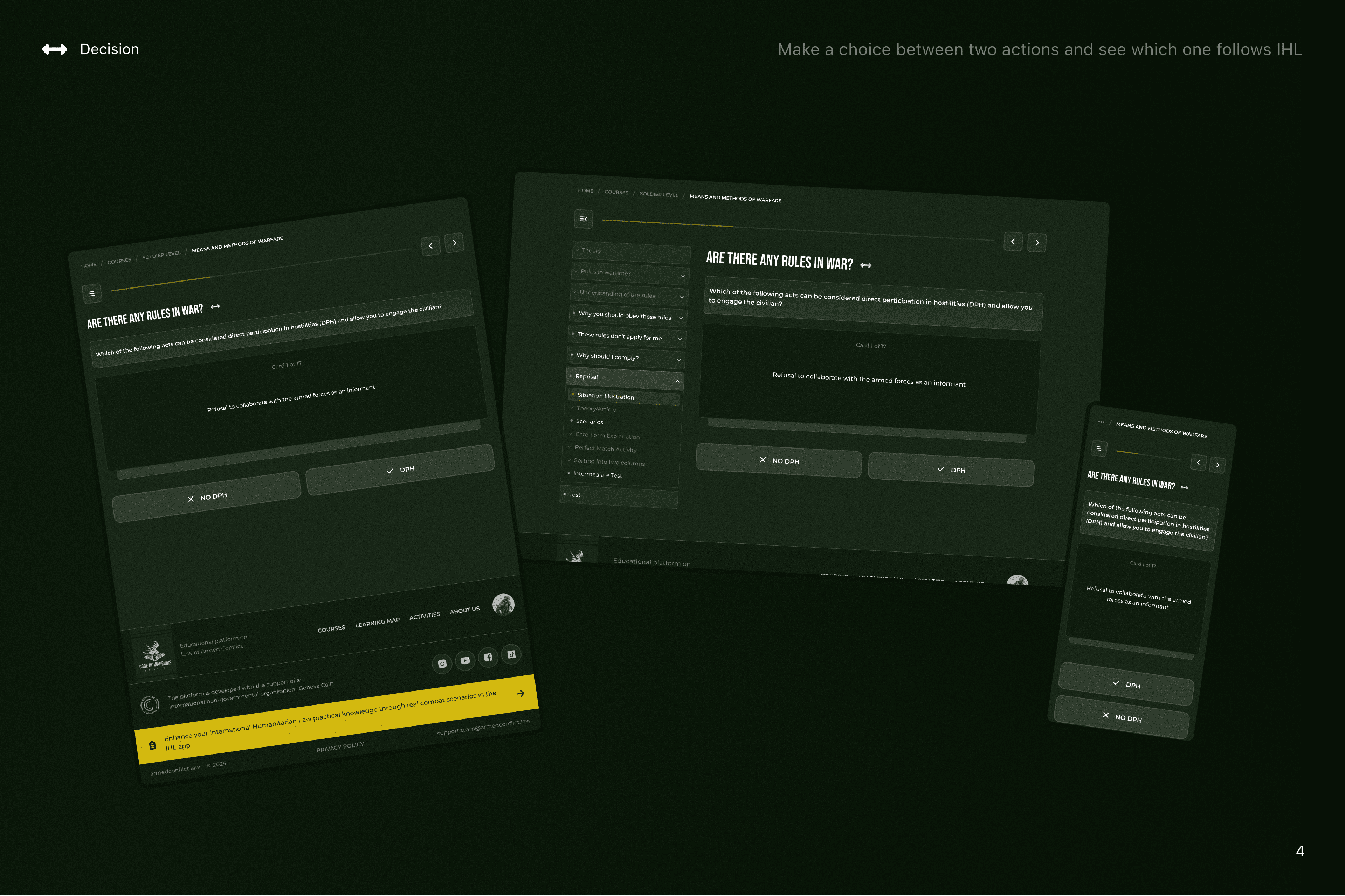
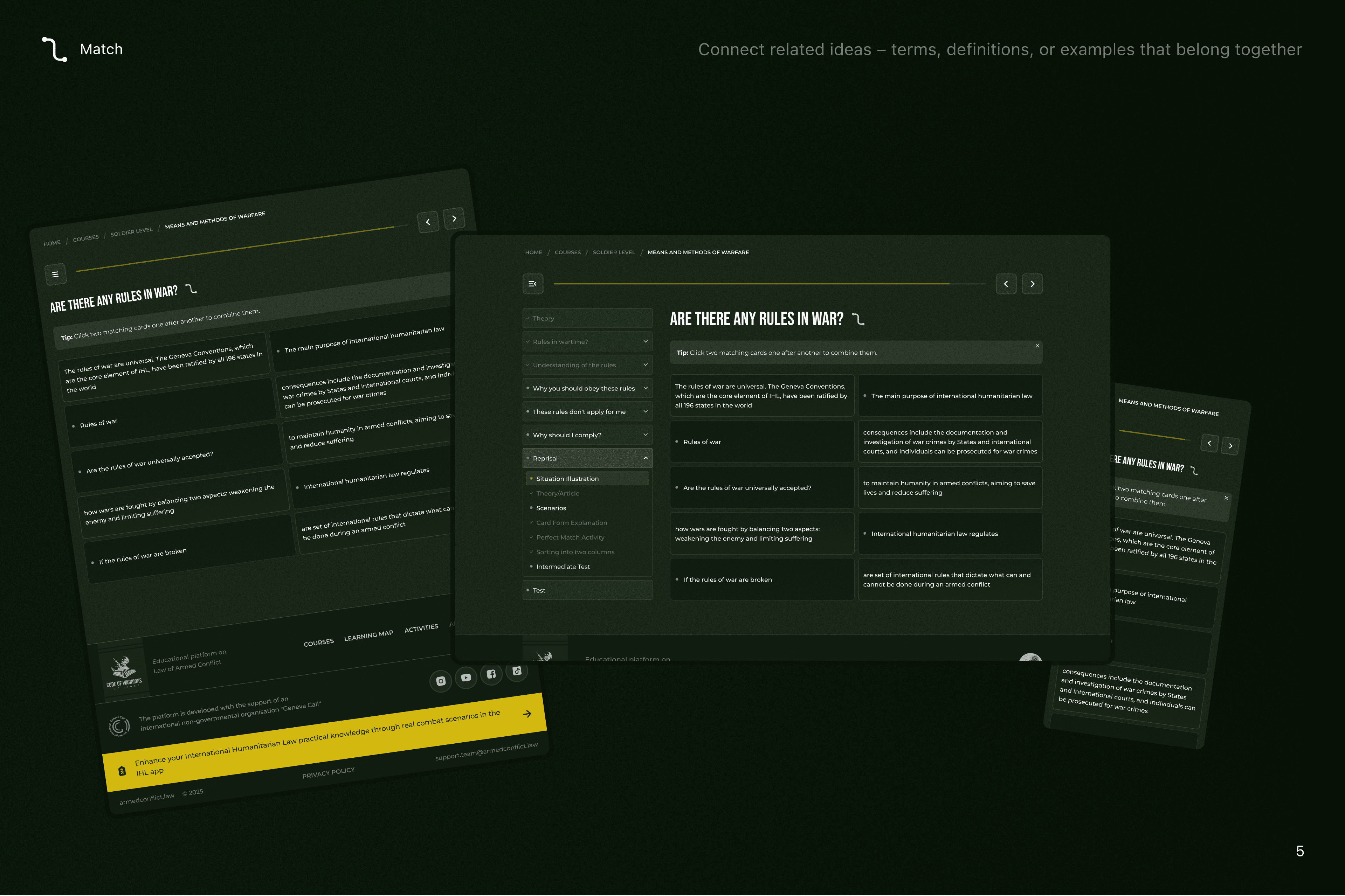
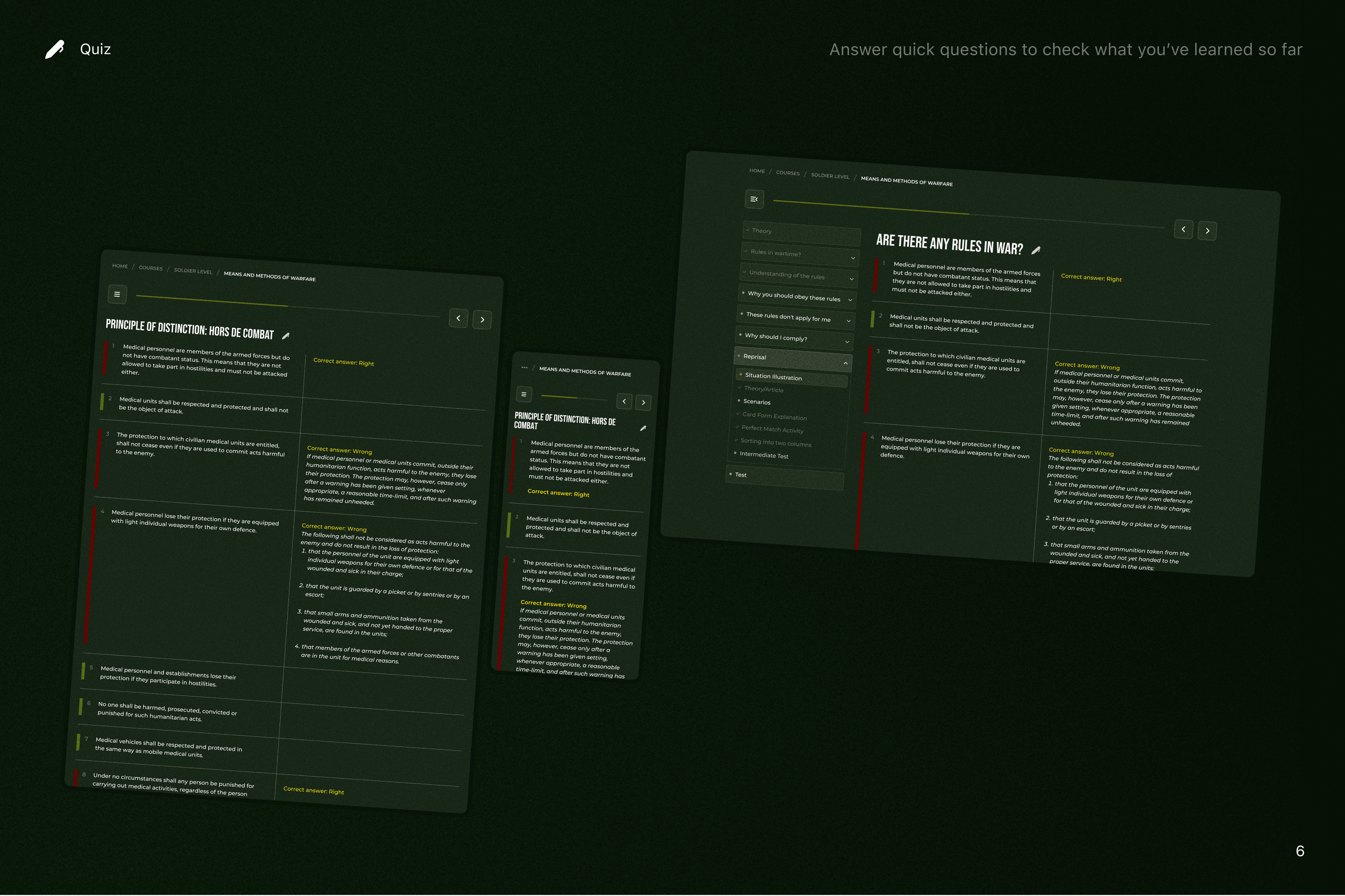
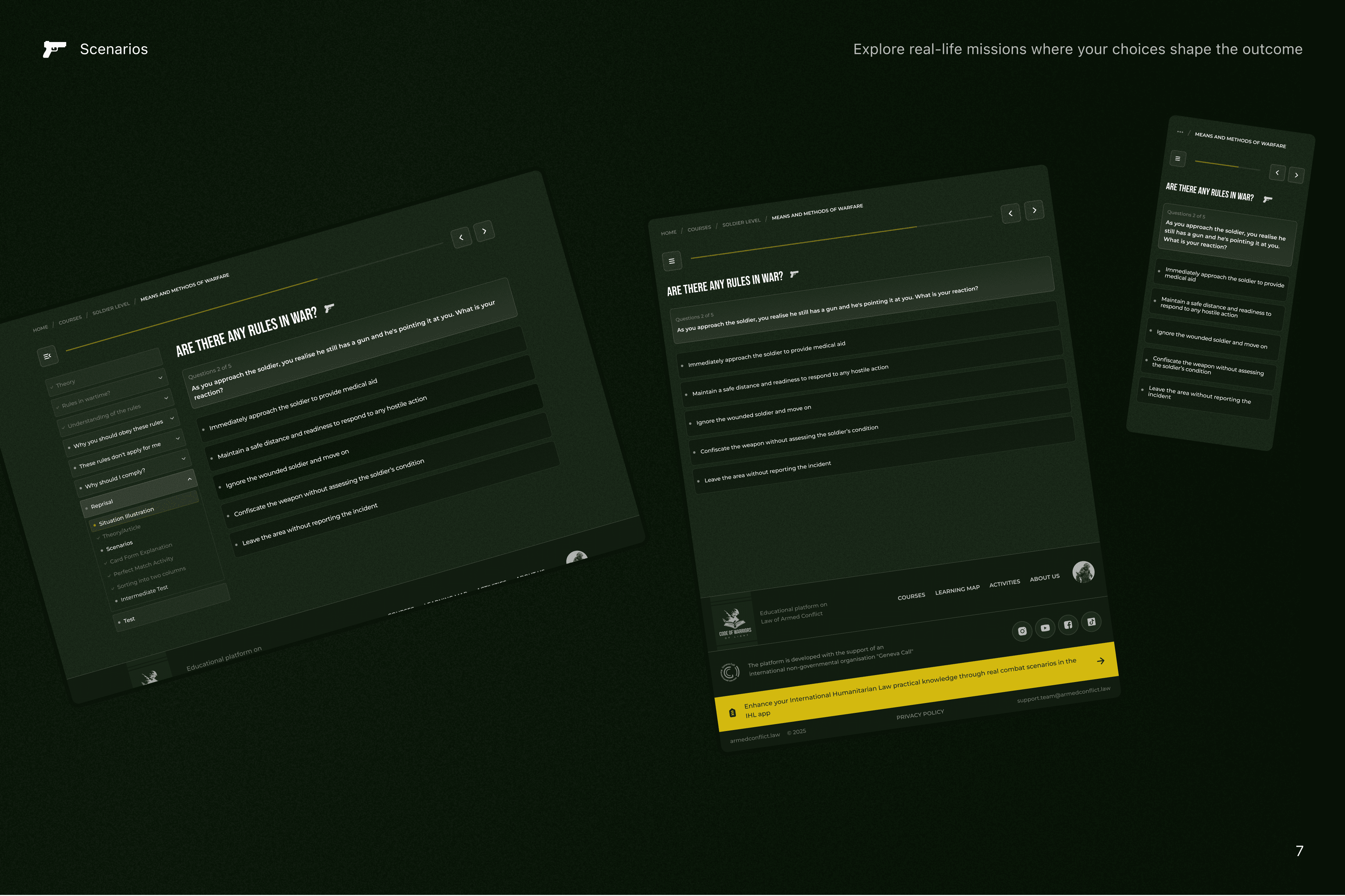
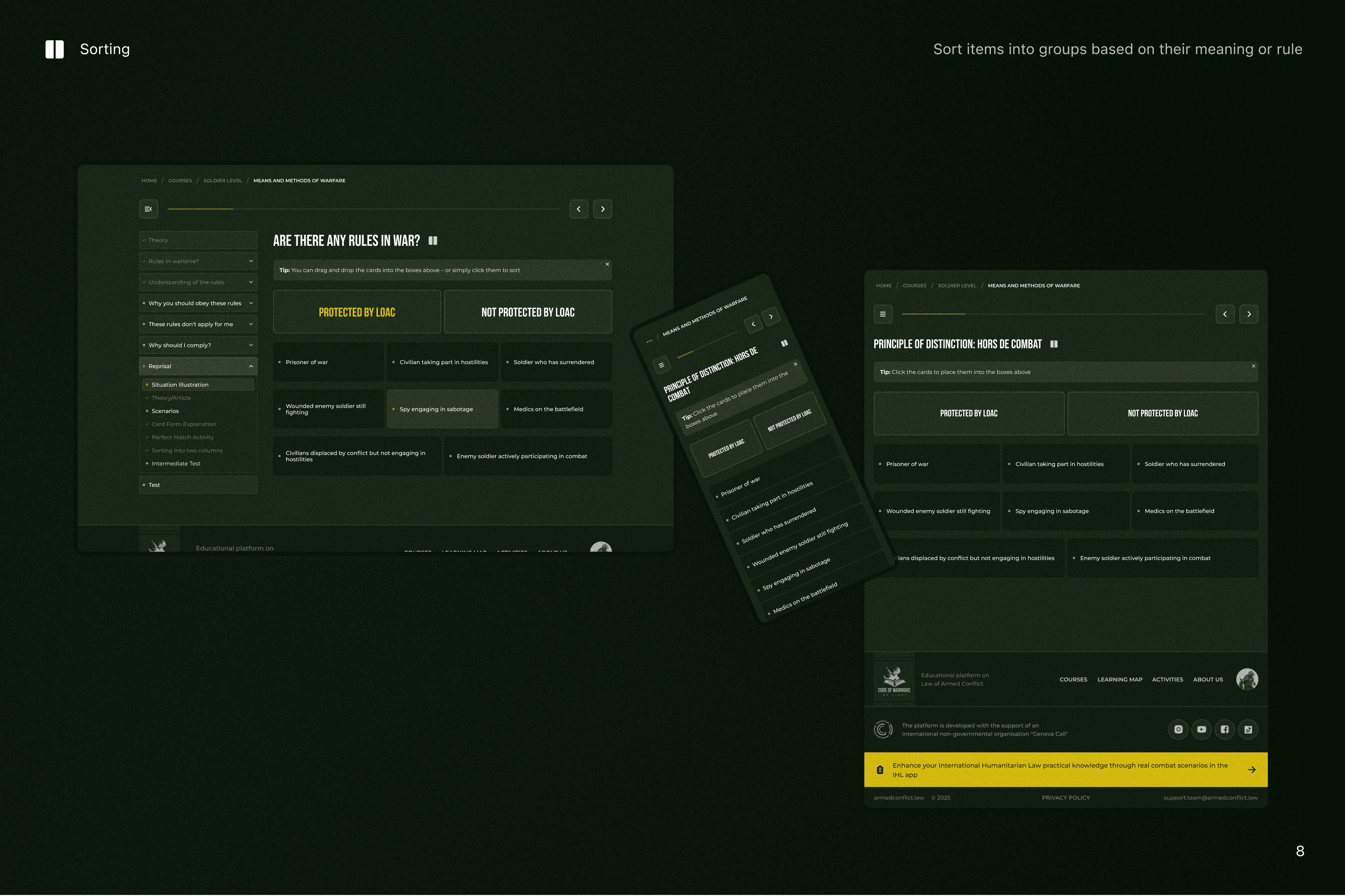
Instead of dumping theory, I used the SCORM standard to break content into bite-sized, interactive blocks. The main activity types were:

Results in the Field
Rolling out a training tool in an active war zone isn’t about viral growth or vanity metrics. Success meant building something credible, usable, and trusted under pressure.
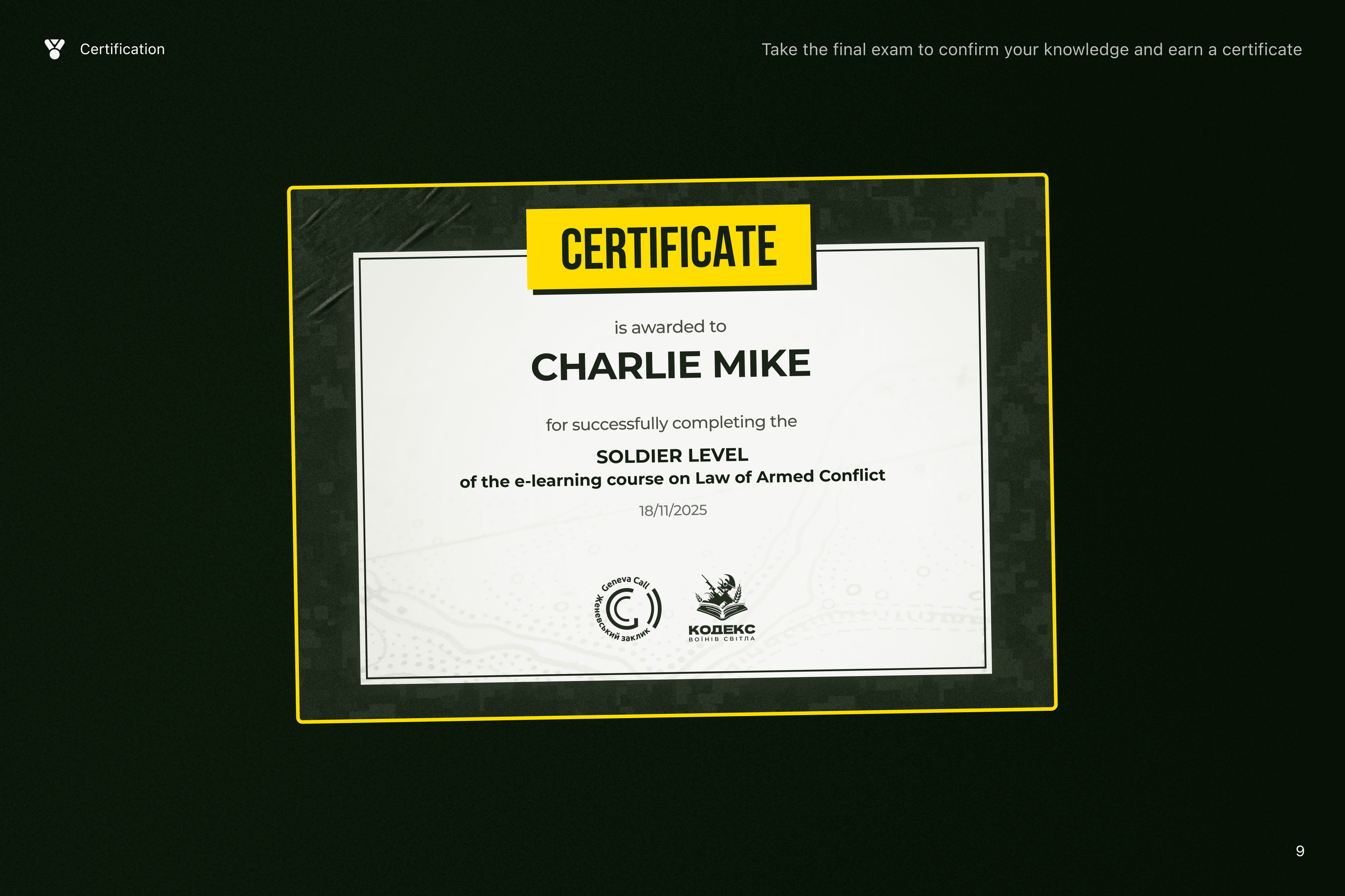
These aren’t corporate e-learning numbers. They reflect reality: soldiers learning between missions, often offline, under pressure. And every certificate means one more soldier ready to uphold IHL where it matters most – in the field.
Impact here isn’t clicks or MAUs. It’s lives protected and dignity preserved.
Users
Onboarded
Full Courses
Completed
Modules
Completed
Soldiers
Certified
*Data collected Between July 2024 and April 2025


Resume
Warriors of
Light Institute
An educational online platform on international humanitarian law Law of Armed Conflict





Research & Discovery | User Insights | Brainstorming | Structure & Flow | Wireframes | UI Design | Prototyping | Testing | Launch & Handoff | Ongoing Improvements
Teaching the Rules of War
In a world where war has once again become a daily reality, the question of how to protect human dignity doesn’t feel abstract – it’s urgent. International Humanitarian Law (IHL), also known as the Law of Armed Conflict, exists to limit harm to civilians and regulate how wars are fought. But rules only matter if people know them.
Geneva Call, a humanitarian organisation working in conflict zones, wanted to make IHL training accessible to Ukrainian military personnel – from soldiers in the trenches to officers in training bases. The goal was clear; the path wasn’t.


From Boring Textbook to Battle-Ready Training Tool
The Challenge
At first, we were handed a massive trove of IHL theory. Expertly written, yes. Engaging? Not at all. Imagine sitting at a base with no signal, trying to read something that feels like a high school law book. That’s not how anyone learns under stress.
I knew this approach wouldn’t work. So the question became: what would IHL training look like if it was designed for someone learning between tasks, with minutes to spare and no internet?
No Time, No Internet
Our first assumption was right: most soldiers had limited or unstable internet access. Add to that the biggest barrier of all – time. Long lectures and big articles were out of the question.
This meant rethinking everything from the ground up. But guesswork only goes so far. Before making design decisions, I turned to the people who mattered most – the users. I moved quickly from desk research and team notes to surveys and interviews with soldiers and trainers. Their insights shaped every choice.
Listening First: What Soldiers Told Me
To make sure I wasn’t just building from assumptions, we ran interviews and surveys with both regular soldiers and senior personnel involved in shaping training and policy
What Interviews Showed
Conversations happened in quick bursts – between rotations, on the move, or in rare moments of quiet. Despite different roles, a few truths stood out:
- Training had to be flexible, intuitive, and short. Soldiers only had minutes, not hours.
- Interactive beats passive — videos, images, quizzes worked better than text.
- Duolingo was the benchmark for engaging learning.
- Credibility mattered: many thought IHL was invented by outsiders, but it was actually written by commanders with real battlefield experience.
What the Surveys Showed
Survey results confirmed and expanded on these insights:
- 49% had stable internet, 44% had interruptions, 7% had little or none → offline-first was a must.
- Only 12% used learning platforms daily; almost half rarely used them.
- Main barriers: lack of time (46%), motivation (23%), poor internet (19%), heavy theory (12%).
- The takeaway: this wasn’t about adding more content — it was about making every minute count.

Internet Access
Most users couldn’t rely on stable internet – the training needed to work even offline
Stable
49%
Interrupted
44%
Poor/None

Barriers to Learning
Training had to be short, engaging, and connection-proof
Lack of time
46%
Motivation
23%
Poor internet
19%
Heavy theory
12%
Prototyping the Experience
With input from interviews and surveys, I moved from sketches to wireframes to full mockups. Two distinct learning paths emerged — Soldier and Officer — each tailored in tone and content.
To keep learning clear and motivating, I designed a visual learning map. It gave soldiers a sense of structure: showing what they’d completed, what came next, and making it easy to jump back to earlier lessons.
And because connectivity was unreliable, the platform was built offline-first: lessons downloaded locally, progress synced later. Each module lasted just a few minutes — short enough to complete in downtime, long enough to stick.
Offline-First Design
Lessons could be downloaded and stored locally, so soldiers could keep learning even without signal. Progress synced automatically once back online.
Bite-Sized Learning
Content was broken into short, reusable modules using SCORM. Each piece was interactive, flexible, and designed for quick learning in high-pressure contexts.
Interactive Activities
From videos and soldier dialogues to scenarios, quizzes, and matching games — learning stayed active, not passive.
Gamification
Progress unlocked new “Military Rank” levels. Simple, lightweight gamification gave users a sense of achievement and motivation to continue.
Additional Exercises
A separate Activities page offered optional practice — scenarios, tests, and extra materials — for those who wanted to go deeper without cluttering the main path.
Myths Busters
Right at onboarding, I cleared up a common misconception: IHL was written by experienced commanders, not outsiders. That context built trust from the start.

Designing for Engagement
Instead of dumping theory, I used the SCORM standard to break content into bite-sized, interactive blocks. The main activity types were:
Results in the Field
Rolling out a training tool in an active war zone isn’t about viral growth or vanity metrics. Success meant building something credible, usable, and trusted under pressure.
These aren’t corporate e-learning numbers. They reflect reality: soldiers learning between missions, often offline, under pressure. And every certificate means one more soldier ready to uphold IHL where it matters most – in the field.
Impact here isn’t clicks or MAUs. It’s lives protected and dignity preserved.
Users
Onboarded
Full Courses
Completed
Modules
Completed
Soldiers
Certified
*Data collected Between July 2024 and April 2025


Warriors of
Light Institute
An educational online platform on international humanitarian law Law of Armed Conflict





Research & Discovery | User Insights | Brainstorming | Structure & Flow | Wireframes | UI Design | Prototyping | Testing | Launch & Handoff | Ongoing Improvements
Teaching the Rules of War
In a world where war has once again become a daily reality, the question of how to protect human dignity doesn’t feel abstract – it’s urgent. International Humanitarian Law (IHL), also known as the Law of Armed Conflict, exists to limit harm to civilians and regulate how wars are fought. But rules only matter if people know them.
Geneva Call, a humanitarian organisation working in conflict zones, wanted to make IHL training accessible to Ukrainian military personnel – from soldiers in the trenches to officers in training bases. The goal was clear; the path wasn’t.


From Boring Textbook to Battle-Ready Training Tool
The Challenge
At first, we were handed a massive trove of IHL theory. Expertly written, yes. Engaging? Not at all. Imagine sitting at a base with no signal, trying to read something that feels like a high school law book. That’s not how anyone learns under stress.
I knew this approach wouldn’t work. So the question became: what would IHL training look like if it was designed for someone learning between tasks, with minutes to spare and no internet?
No Time, No Internet
Our first assumption was right: most soldiers had limited or unstable internet access. Add to that the biggest barrier of all – time. Long lectures and big articles were out of the question.
This meant rethinking everything from the ground up. But guesswork only goes so far. Before making design decisions, I turned to the people who mattered most – the users. I moved quickly from desk research and team notes to surveys and interviews with soldiers and trainers. Their insights shaped every choice.
Listening First: What Soldiers Told Me
To make sure I wasn’t just building from assumptions, we ran interviews and surveys with both regular soldiers and senior personnel involved in shaping training and policy
What Interviews Showed
Conversations happened in quick bursts – between rotations, on the move, or in rare moments of quiet. Despite different roles, a few truths stood out:
- Training had to be flexible, intuitive, and short. Soldiers only had minutes, not hours.
- Interactive beats passive — videos, images, quizzes worked better than text.
- Duolingo was the benchmark for engaging learning.
- Credibility mattered: many thought IHL was invented by outsiders, but it was actually written by commanders with real battlefield experience.
What Surveys Showed
Survey results confirmed and expanded on these insights:
- 49% had stable internet, 44% had interruptions, 7% had little or none → offline-first was a must.
- Only 12% used learning platforms daily; almost half rarely used them.
- Main barriers: lack of time (46%), motivation (23%), poor internet (19%), heavy theory (12%).
- The takeaway: this wasn’t about adding more content — it was about making every minute count.

Internet Access
Most users couldn’t rely on stable internet – the training needed to work even offline
Stable
Interrupted
Poor/None
Barriers to Learning
Training had to be short, engaging, and connection-proof
Lack of time
Motivation
Poor internet
Heavy theory
Prototyping the Experience
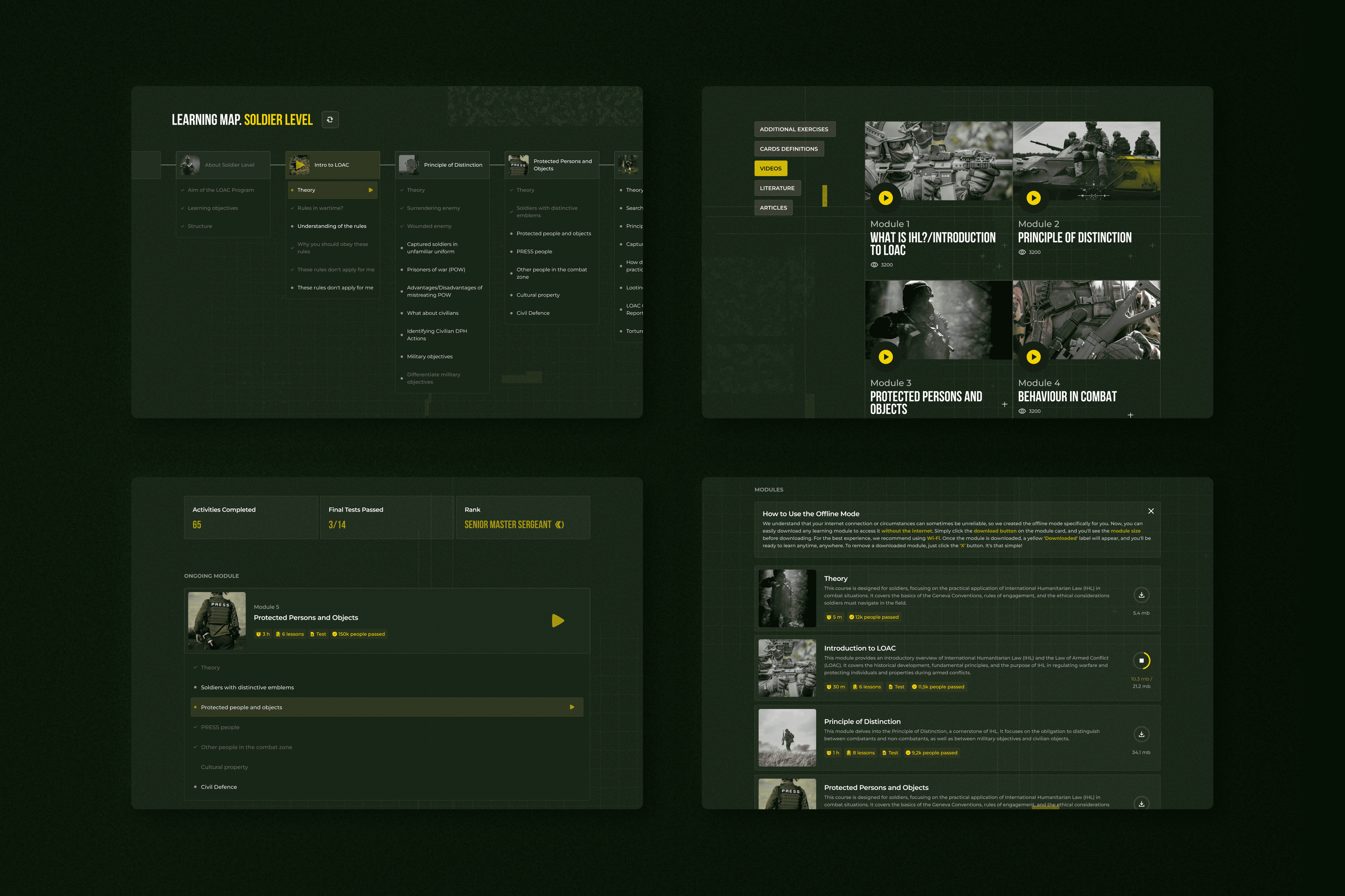
With input from interviews and surveys, I moved from sketches to wireframes to full mockups. Two distinct learning paths emerged — Soldier and Officer — each tailored in tone and content.
To keep learning clear and motivating, I designed a visual learning map. It gave soldiers a sense of structure: showing what they’d completed, what came next, and making it easy to jump back to earlier lessons.
Connectivity was patchy, so lessons had to live offline first. Soldiers could download content, keep learning in the field, and sync progress later when a signal returned.
Offline-First Design
Lessons could be downloaded and stored locally, so soldiers could keep learning even without signal. Progress synced automatically once back online.
Bite-Sized Learning
Content was broken into short, reusable modules using SCORM. Each piece was interactive, flexible, and designed for quick learning in high-pressure contexts.
Interactive Activities
From videos and soldier dialogues to scenarios, quizzes, and matching games — learning stayed active, not passive.
Gamification
Progress unlocked new “Military Rank” levels. Simple, lightweight gamification gave users a sense of achievement and motivation to continue.
Additional Exercises
A separate Activities page offered optional practice — scenarios, tests, and extra materials — for those who wanted to go deeper without cluttering the main path.
Myths Busters
Right at onboarding, I cleared up a common misconception: IHL was written by experienced commanders, not outsiders. That context built trust from the start.

Designing for Engagement
Instead of dumping theory, I used the SCORM standard to break content into bite-sized, interactive blocks. The main activity types were:
Results in the Field
Rolling out a training tool in an active war zone isn’t about viral growth or vanity metrics. Success meant building something credible, usable, and trusted under pressure.
These aren’t corporate e-learning numbers. They reflect reality: soldiers learning between missions, often offline, under pressure. And every certificate means one more soldier ready to uphold IHL where it matters most – in the field.
Impact here isn’t clicks or MAUs. It’s lives protected and dignity preserved.
Users
Onboarded
Full Courses
Completed
Modules
Completed
Soldiers
Certified
*Data collected Between July 2024 and April 2025

